
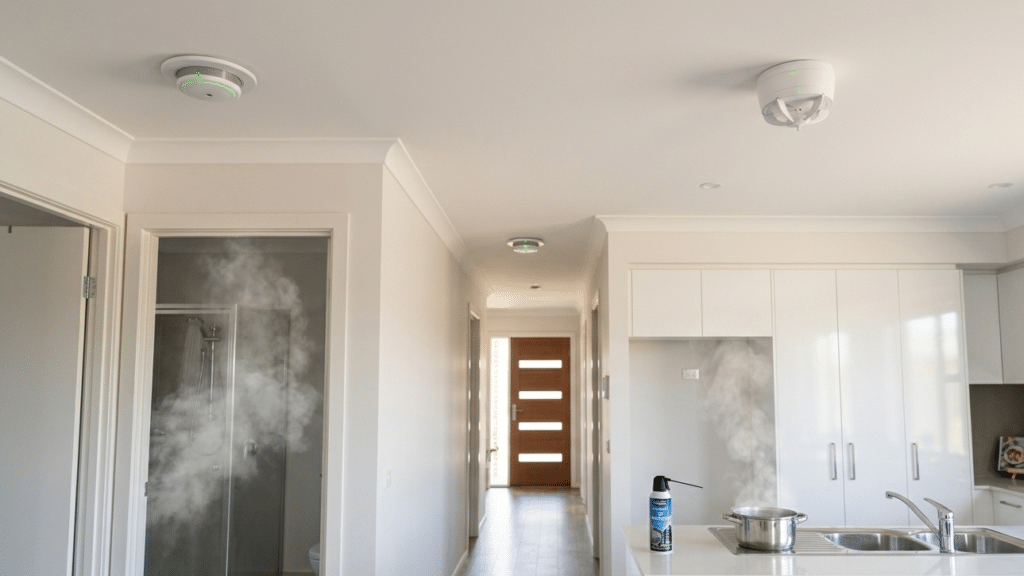
Few things are more disruptive than a smoke alarm going off mid-meal. Whether it’s steam from the shower, toast burning slightly, or just cooking at high heat, false alarms are one of the most common complaints we hear from NZ homeowners.
The frustrating part is that false alarms often lead people to do exactly the wrong thing: they remove the battery or disable the alarm entirely. That creates a real safety risk. Understanding why false alarms happen, and how to prevent them, means you can keep your alarm active and your home protected.
Why Do Smoke Alarms Trigger Falsely?
Most modern smoke alarms use photoelectric technology, which detects visible smoke particles by bouncing a light beam inside a detection chamber. This is excellent at detecting slow, smouldering fires. But it also means anything that mimics smoke particles can trigger the alarm.
Common culprits include:
• Steam from cooking, boiling water, or a hot shower
• Burnt toast or high-heat frying
• Aerosol sprays, hairspray, or deodorant used near an alarm
• Dust accumulation inside the chamber over time
• Insects entering the detection chamber
• High humidity or condensation in bathrooms and laundry areas
• Candles, incense, or cigarette smoke drifting toward the alarm
Our frequently asked questions page covers a number of these common triggers in more detail, including practical steps to resolve them.
Where You Place Your Alarm Makes a Big Difference
Incorrect placement is one of the most overlooked causes of false alarms. Even a well-designed alarm will trigger frequently if it’s positioned in the wrong spot.
Avoid these locations:
• Kitchens, garages, and laundries (install a heat alarm in these spaces instead)
• Directly above cooking areas or stovetops
• Near bathroom doors where steam travels
• Within 100cm of an HVAC system, heat pump, or air conditioning unit
• Within 40cm of a ceiling fan
• In corners or dead air zones (within 30cm of a wall/ceiling join, or within 50cm of an apex ceiling)
• Within 50cm of an LED light fitting
Better placement practices:
• Install in the centre of the ceiling in the room it is meant to protect
• Keep at least 50cm from any cooking appliance
• In open-plan kitchen/living spaces, position the alarm as far from the cooking zone as practical
• In kitchens, sculleries, and garages, use a wireless heat alarm rather than a smoke alarm
For full placement guidance aligned to NZS 4514:2021, visit our NZ Building Code page.
The Role of Heat Alarms in False Alarm Prevention
Heat alarms do not detect smoke at all. Instead, they respond to a rapid rise in temperature or when a fixed temperature threshold is reached. This makes them ideal for areas where steam, grease, and airborne particles are common.
Under the updated NZ Building Code, kitchens and sculleries separated by doors should have a heat alarm installed rather than a smoke alarm. This is specifically to reduce nuisance activations while still providing early fire detection in those spaces.
If you are unsure whether you need a smoke alarm, a heat alarm, or both, our article How to Choose Between a Heat Alarm and a Smoke Alarm walks through the key differences.
Maintenance Tips to Reduce False Triggers
Even a correctly placed alarm can false-trigger if it hasn’t been maintained. Dust and insects are significant contributors to nuisance alarms, particularly in older installations.
Regular maintenance checklist:
• Vacuum around the smoke chamber (the grey mesh) every six months using a brush attachment on the lowest setting
• Do not open the alarm casing or use water or household cleaners on it
• Test the alarm monthly by pressing the test button
• Check the LED indicator weekly (it should flash every 48 seconds to confirm operation)
• Replace your alarm at the 10-year mark, as sensor sensitivity degrades over time
We cover this in more detail in our guide on how to maintain a smoke alarm for long-term reliability.
When Humidity and Temperature Are the Problem
High humidity is a genuine issue in New Zealand homes, particularly in bathrooms, coastal properties, and during humid summer months. All AS3786:2014-compliant alarms are tested to above 90% relative humidity, but when condensation forms inside the detection chamber, false triggers can occur.
If humidity is the issue, running a hairdryer on a warm setting through the chamber filter can help dry the PCB. Activating your heat pump on dry mode is another option. Unfortunately, you cannot control the weather, so in persistently humid environments, alarm positioning becomes even more critical.
What CAVIUS Alarms Do to Reduce False Alarms
CAVIUS photoelectric smoke alarms, available through our wireless interconnected smoke alarms, use advanced chamber design and CORE technology to improve detection accuracy and reduce nuisance triggers. All CAVIUS alarms feature a hush function, allowing you to temporarily silence the alarm during cooking without removing it or disabling the sensor.
The hush function is an important feature because it keeps the alarm active. After a set period, the alarm automatically reactivates, so your home never goes unprotected.
You can explore the full CAVIUS Smoke Alarms range, or find a stockist through our Where to Buy page.
Key Takeaways
False alarms are frustrating, but they are almost always preventable. The most effective steps are:
• Install the right alarm type in the right location
• Use heat alarms in kitchens, garages, and laundries
• Keep alarms away from steam sources, vents, and dead air zones
• Maintain your alarms with regular vacuuming and monthly testing
• Use the hush function rather than removing or disabling your alarm
A false alarm is not a reason to remove your smoke alarm. It is a reason to reposition it, maintain it, or upgrade to a better-suited device for that space. Getting this right means your alarms will be there when it actually matters.